<?xml version="1.0" encoding="utf-8"?>
<feed xmlns="http://www.w3.org/2005/Atom">
  <title>Flexion</title>
	<subtitle></subtitle>
	<link href="https://flexion.tech/feed.xml" rel="self"/>
	<link href="https://flexion.tech/"/>
	<updated>2020-02-19T10:17:58.728-00:00</updated>
	<id>https://flexion.tech</id>
	<author>
  <name>James Foran</name>
  <email>james@flexion.tech</email>
	</author>
	
  
  <entry>
    <title>Dimensional Weight - In depth</title>
    <link href="https://flexion.tech/posts/dimensional-weight-in-depth/"/>
    <updated>2020-05-20T13:17:59.818-00:00</updated>
    <id>https://flexion.tech/posts/dimensional-weight-in-depth/</id>
    <content type="html"><![CDATA[
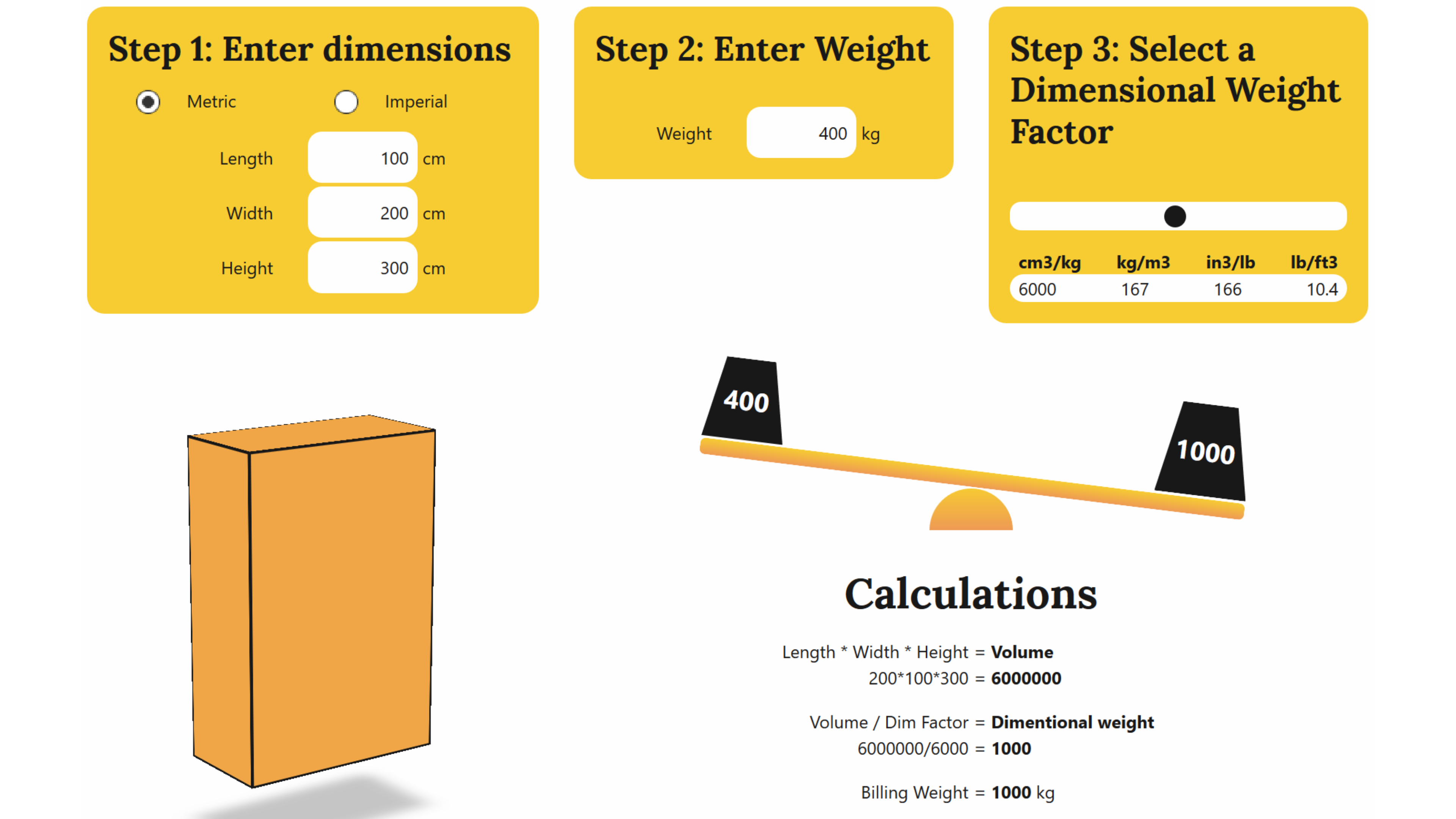
      <p>If you are already in the know, you can jump straight to <a href="/dim-weight">the tool here,</a> if not, please read on.</p>
 <figure>
  <img src="/images/dim-weight@2x.png" alt="dimensional weight tool screen shot" loading="lazy">
  <figcaption>Screen shot of dimesional weight tool</figcaption>
</figure> 
<h1>Dimensional Weight</h1>
<p>Dimensional weight. it is a pretty basic concept that is used by transport companies to when calculating freight charges, rather than relying on gross weight alone. This dimensional weight comes into effect often when shipping high volume, low weight items. When charging based on weight, which ever is greater between the dimensional weight, and the actual weight, is used when calculating the charges.</p>
<p>This mechanism is an incentive to shippers of low density products to reduce unnecessary packaging. it can also be a surprise to unsuspecting consumers, who are not aware of how each transport company calculates dimensional weight.</p>
<p>To calculation dimensional weight, first you must calculate volume. For this discussion we will assume that volume is calculated either in cubic centimetres, or cubic inches.</p>
<h1>Calculating Volume</h1>
<p>The calculation is very simple:</p>
<p><code>Length * Width * Height = Volume</code></p>
<p><code>volume/dimensional rate factor</code></p>
<p>If what you are shipping is not cuboid, you must take the maximum value of each dimension. This means if you are shipping a cylinder, the measurement would be length  * diameter *  diameter.</p>
<h1>Calculating Dimensional Weight</h1>
<p>Dimensional rate factors is where things get a little confusing. They can be expressed in two different ways.</p>
<p>Volume per Weight Unit, or, weight per volume unit. to show a simple example, lets take a look at an example using Cubic CM an kilograms. The example factor we will use is 5000cm3 per 1 kilo.</p>
<p>Lets calculate volume:</p>
<p><code>100cm * 100cm * 100cm = 1000000cm3</code></p>
<p>to calculate Dimensional weight:</p>
<p><code>1000000/5000 = 200kg</code></p>
<p>Now, to express the same dimensional rate factor, in terms of weight per volume unit, the number of kilograms per cubic meter is used. a cubic meter just happens to equal 1000000cm3, so from above, we can see that the equivalent expression of 5000cm3 per kilogram, is 200kg per cubic meter. To calculate dimensional weight using this measure, you need the following formula:</p>
<p><code>1000000/100000 * 200 = 200kg</code></p>
<p>Lets take a slightly more interesting example:</p>
<p><code>120*120*120 = 1728000</code></p>
<p><code>1728000/1000000 * 200 = 345.6kg</code></p>
<h1>Dimensional Rate factors</h1>
<p>So, with some pretty basic math, we can calculate dimensional weight. One place it gets tricky is working with different carriers, who all seem to have their own way of communicating dimensional rate factors.</p>
<p>Some will use cm3/kg, others kg/m3, and then their is the is the imperial measurements. FedEx for example used 139 cubic inches per pound, or 139in3/lb. This is where my brain fails me. Unfortunately my dad is not always around to do these conversions!</p>
<p>Luckily, there is some hope. The seemingly random in3/lb values are actually based on the metric standards, so 139in3/lb is equivalent to 5000cm3/kg. The same goes for all other examples I was able to find.</p>
<table>
<thead>
<tr>
<th style="text-align:center">cm3/kg</th>
<th style="text-align:center">kg/m3</th>
<th style="text-align:center">in3/lb</th>
<th style="text-align:center">lb/ft3</th>
</tr>
</thead>
<tbody>
<tr>
<td style="text-align:center">3000</td>
<td style="text-align:center">333</td>
<td style="text-align:center">83</td>
<td style="text-align:center">20.8</td>
</tr>
<tr>
<td style="text-align:center">4000</td>
<td style="text-align:center">250</td>
<td style="text-align:center">110</td>
<td style="text-align:center">15.6</td>
</tr>
<tr>
<td style="text-align:center">5000</td>
<td style="text-align:center">200</td>
<td style="text-align:center">139</td>
<td style="text-align:center">12.5</td>
</tr>
<tr>
<td style="text-align:center">6000</td>
<td style="text-align:center">167</td>
<td style="text-align:center">166</td>
<td style="text-align:center">10.4</td>
</tr>
<tr>
<td style="text-align:center">7000</td>
<td style="text-align:center">143</td>
<td style="text-align:center">194</td>
<td style="text-align:center">8.9</td>
</tr>
<tr>
<td style="text-align:center">8000</td>
<td style="text-align:center">125</td>
<td style="text-align:center">221</td>
<td style="text-align:center">7.8</td>
</tr>
<tr>
<td style="text-align:center">9000</td>
<td style="text-align:center">111</td>
<td style="text-align:center">250</td>
<td style="text-align:center">6.9</td>
</tr>
</tbody>
</table>
<p>Taking the above dimensional rate factors, and applying it to an example volume, we get the following result:</p>
<p><code>1728000/3000 = 345.6kg</code></p>
<p><code>1728000/9000= 192kg</code></p>
<p>It is literally 3 times lighter. If you are shipping low density goods, know your dim rate factors, and reduce the size of your packaging as much as possible.</p>
<p>To help further articulate dimensional weight, I have built a small tool that can help you calculate dimensional weight easily, which can be found <a href="/dim-weight">here.</a></p>
<p>Hope you enjoy playing around with it! If you find it useful, or think others will, please share it too!</p>

    ]]></content>
  </entry>
	
  
  <entry>
    <title>Postal vs Parcel</title>
    <link href="https://flexion.tech/posts/postal-vs-parcel/"/>
    <updated>2020-05-03T15:00:00-00:00</updated>
    <id>https://flexion.tech/posts/postal-vs-parcel/</id>
    <content type="html"><![CDATA[
      <img class="width-half " src="/images/parcel-vs-post@2x.png" alt="Package at front door" loading="lazy">
<p>If your household is anything like mine, you have seen a huge increase in the number of parcels that have been delivered to your house in the last month. With the entire world is seemingly in some form of lockdown, online shopping is one of the only &quot;normal&quot; things that we have left in our lives. But how do all these items make it to your house? It appears to be quite different from the postal network that delivers our 🐌mail. You cannot simply write an address on a box, and send it! Lets start by taking a look at the post...</p>
<h1>The Post</h1>
<img class="width-half " src="/images/flexion-email.svg" alt="Package at front door" loading="lazy">
<p>Have you ever wondered why it is called POST? Apparently, back in the day, the mail used to be nailed to a POST in the centre of town and eventually, the mail-bag was nailed to a post, and people used to go a &quot;check the post&quot;.  There were posts between towns, and mail was transferred between POSTS, forming the first postal network.  If you want to find out more head to <a href="https://en.wikipedia.org/wiki/Mail#History">Wikipedia</a>.</p>
<p>Things have changed a little now. Every single house now has its very own post(box), and the postal network extends across the entire globe! Pretty amazing really. You can even send a letter to the north pole!</p>
<p>To send a letter, all you have to do is write an address, preferably neatly, and ideally, at least in Australia, you will write the postcode in the 4 small boxes provided. Next, you affix a stamp, which is how you pay for the service, and drop the letter in a post box.</p>
<p><img src="/images/blank_envelope.png" alt="blank envelope"></p>
<p>From there, the mail goes to a local sort facility, starting its multi-leg journey to the recipient. Automatic sort systems can process over 50,000 letters an hour. For letters staying in-country, sort is done based on the postcode (aka zip code). The systems that read the address have a pretty tough job. But, they do it quickly, and when required, they print a postal barcode on the envelope or postcard, which is then used to sort the mail automatically through the rest of the network.</p>
<p><img src="/images/postcard.png" alt="post-card barcode"></p>
<p>Above is a postcard my son received recently. You can see the 4 state barcode faintly on the letter.</p>
<p><img src="/images/postal_barcode.png" alt="letter 4 state barcode"></p>
<p>Above is another example of a 4 state barcode on a letter. These are printed on the letter by the sender, and are almost always BILLS! For more info on these, read <a href="https://auspost.com.au/content/dam/auspost_corp/media/documents/barcoding-fact-sheet-oct14.pdf">this article from Australia Post</a>.</p>
<h1>Parcel</h1>
<p>Today, postal networks are now capable of handling small, non-flat parcels too. But for this discussion, we are going to focus on parcels that do not go via regular post.</p>
<p>So how do parcel networks vary from postal networks? The result is much the same. The items being delivered ends up at the recipient address. Simple. But, several things make it more complex. Letters are generally flat and are a fairly standard size. There is only 1 place you can write an address on an envelope. A Parcel on the other hand, generally has 6 sides and will vary in shape, dimensions and weight! You can stick a freight label anywhere you want.</p>
<p>Parcel networks also have far fewer nodes. While most towns will have a post office, each major city may have only 1 parcel sort facility per network.</p>
<p>There is no single parcel network. While national postal companies offer this service, they are not alone. Many logistics organisations have a parcel delivery service, and event within single organisations, multiple parcel networks may, and do exist.
But to send a parcel, you do not write the address on the box. you have to stick a label on the box, that contains a whole lot more information than just an address.</p>
<h1>Freight Label</h1>
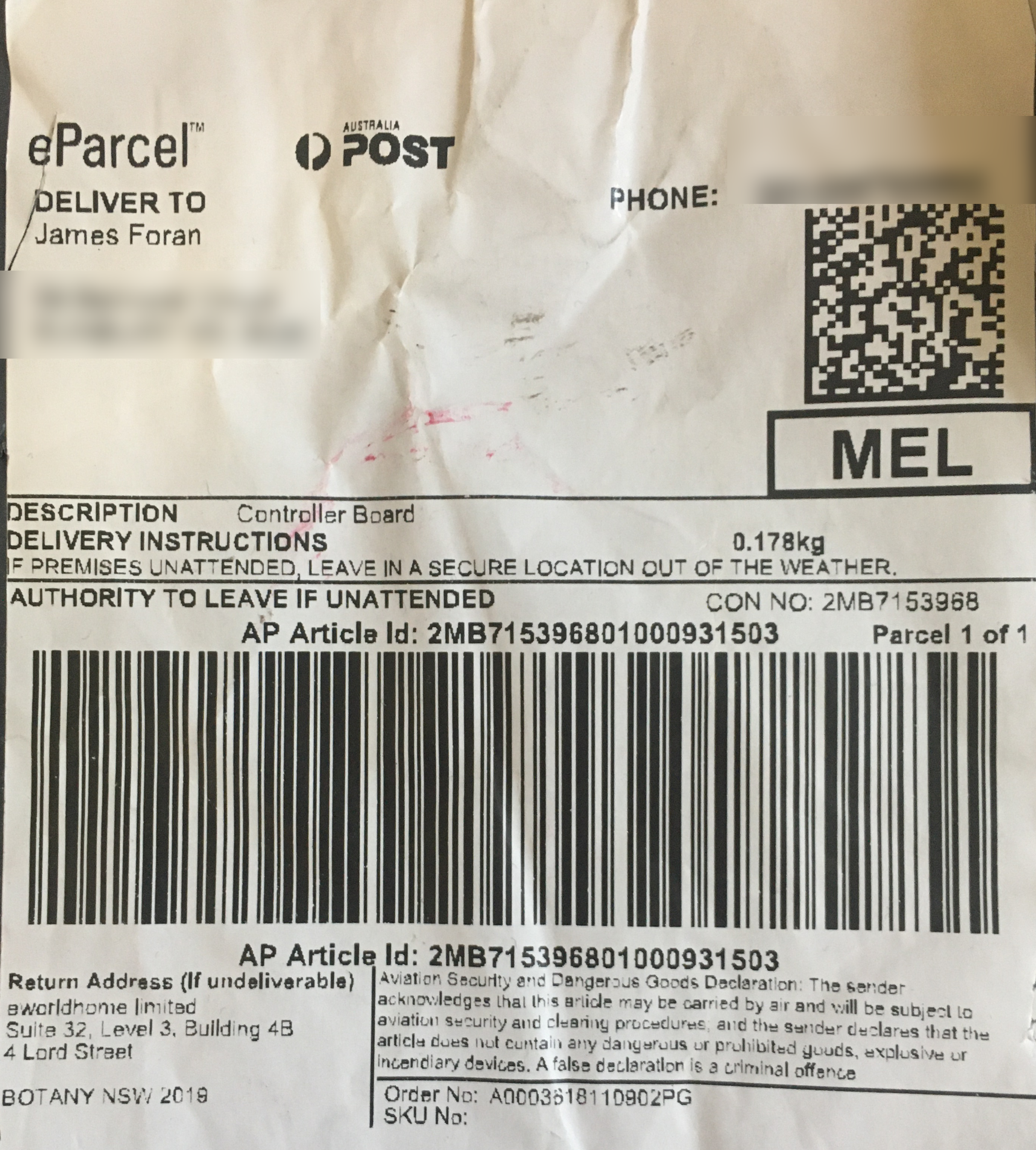
<p><img src="/images/parcel_label2.png" alt="Australia Post Label"></p>
<p>So the Freight label is quite a strange one... What is all that extra information?</p>
<p>The label above is a mixture of machine readable barcodes, and human readable information, that will be used throughout the network, to ensure the item is delivered successfully.  Lets take a look at some of extra information we see on freight labels:</p>
<ul>
<li>
<p>Item Barcode: Each <a href="https://flexion.tech/posts/the-life-of-a-con/">Consignment</a> can be made up of multiple freight items. Each freight item must be uniquely identified so it can be routed through the network. If you are sending 4 items in a single consignment, each item is individually labelled and tracked.</p>
</li>
<li>
<p>MEL  It actually stands for Melbourne. This is a visual aid that will help this parcel get onto the correct linehaul truck, should automated sort systems be unavailable. In Australia, this is similar to the first digit of the post code.</p>
</li>
<li>
<p>Delivery Instructions:
This is something we definitely don't see letters. A parcel can contain valuable items though, and having the latest iPhone delivered to your house, and left on the front door step is not ideal. It can also not really be put in the letter box. These delivery instructions help transport companies complete a delivery even when the driver is unable to deliver the items in person at the delivery address.</p>
</li>
<li>
<p>Authority to Leave
This is set per delivery item, and is either set by the sender, or the receiver. For low value items, this is used frequently.<br>
Today, in the current lock-down environment, this is the default, as most people are home.</p>
</li>
<li>
<p>Alternative Delivery Point
If a delivery is not made, then the package may be sent to an alternative location. For Australia Post, this would be the local post office, or sort facility. For other networks, this could be the newsagency, a pharmacy, or anywhere really that is part of the specific network.</p>
</li>
</ul>
<h2>Parcel Networks</h2>
<p>As we mentioned before, there is no single network, meaning there is also no single location where all parcels addressed to you go, before the last leg of the journey. Each parcel carrier will have their own set of hubs/nodes. Unlike the postal network, where the last leg will always start from the local post office, the last leg for parcels can originate from anywhere within a 50-100km radius, depending on where you live.</p>
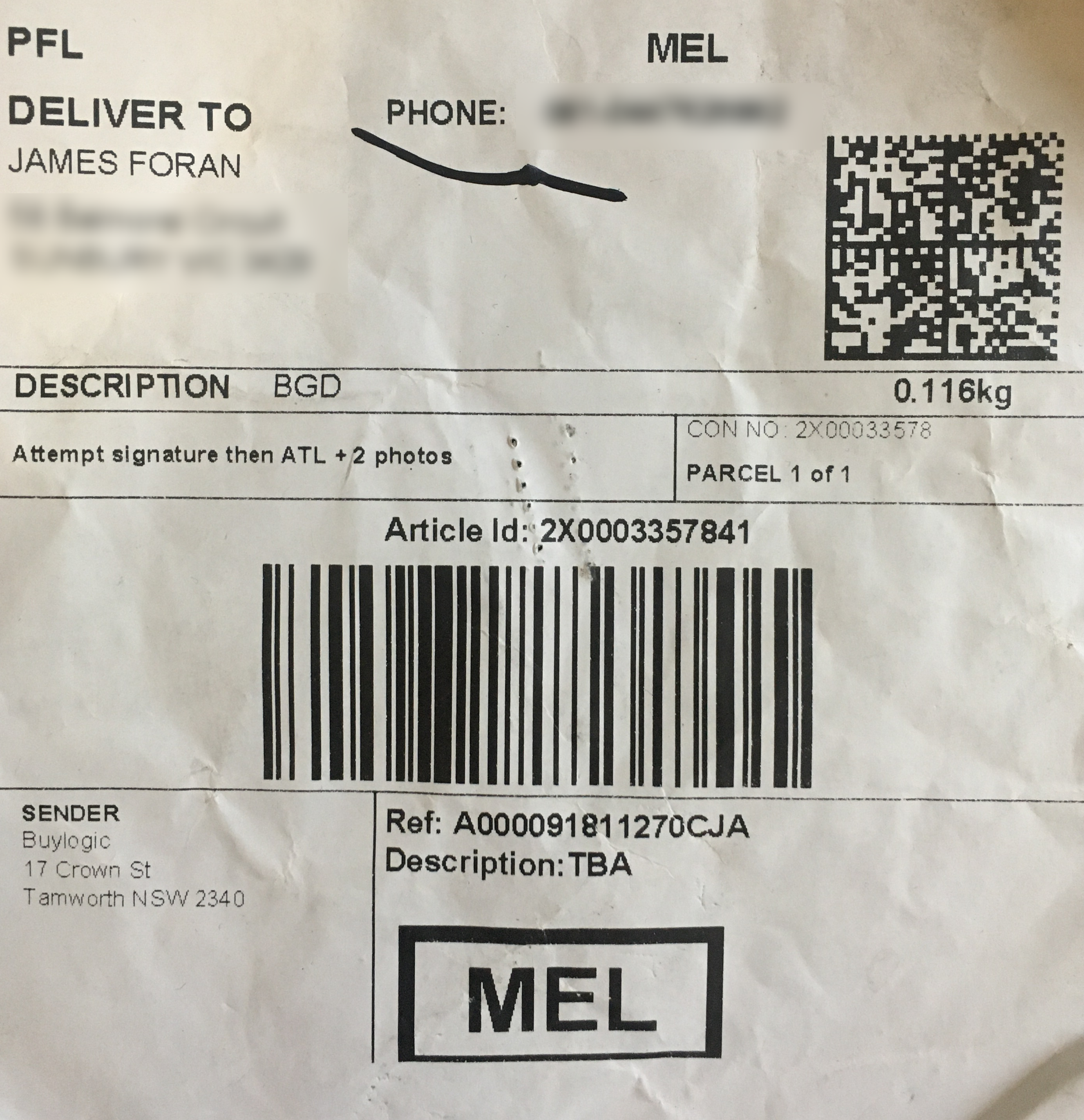
<p><img src="/images/parcel_label1.png" alt="generic freight label"></p>
<p>Another consideration is that each network has a unique automated sort system, if they have one at all. It is more complicated than mail not just due to 6 sides, but also the way logistics companies charge for these services.</p>
<h2>Payment</h2>
<p>In many cases, the freight charges are not pre-paid for parcels. This is in part due to the irregularity of parcel weight and dimensions. Also, drivers doing pickups are not equipped to receive payment for freight as they pick it up. Logistics companies will pickup freight prior invoicing a customer. Once freight makes it to a major hub, it will be automatically measured and weighed. Using this information, billing weights will be calculated. A new article will be out soon dedicated to discussing dimensional weight. Its a tricky one!</p>
<h2>Scanning a Freight Label</h2>
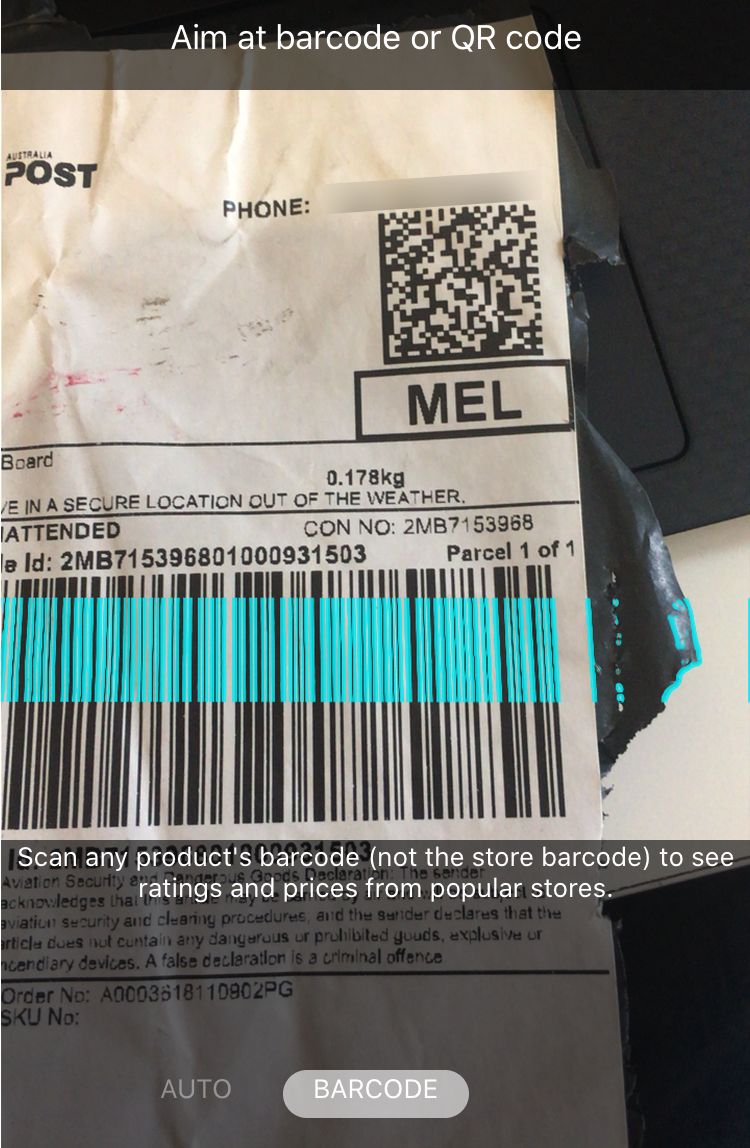
<p><img src="/images/scan_label.png" alt="Scanning a freight label via mobile device"></p>
<p>You can do this at home, with your smart-phone! Yes, that's right. It really is <s>hours</s> minutes of fun. Try it for yourself. Here's how.</p>
<ol>
<li>Open Google Chrome, or Microsoft Edge web browser ( I use an iPhone)</li>
<li>Select a New TAB.</li>
<li>Select the 📷 camera icon. This should open your camera within the app, providing you have given the right permissions.</li>
<li>There should be options at the bottom to select barcode. select this.</li>
<li>Point the camera at a freight barcode. Most 2 dimensional, or 1 dimensional barcodes will work.</li>
<li>The data from the label will then be entered into a google search.</li>
</ol>
<p>The information returned will vary depending on the barcode type. In most cases, it will just be a string of numbers, however, with some QR codes, you should get your actual address returned directly from the scan!</p>
<h2>Label Formats</h2>
<p>The data contained within the barcodes varies greatly. Often that data is just a reference, which on its own means nothing, and other times it will be a physical address!</p>
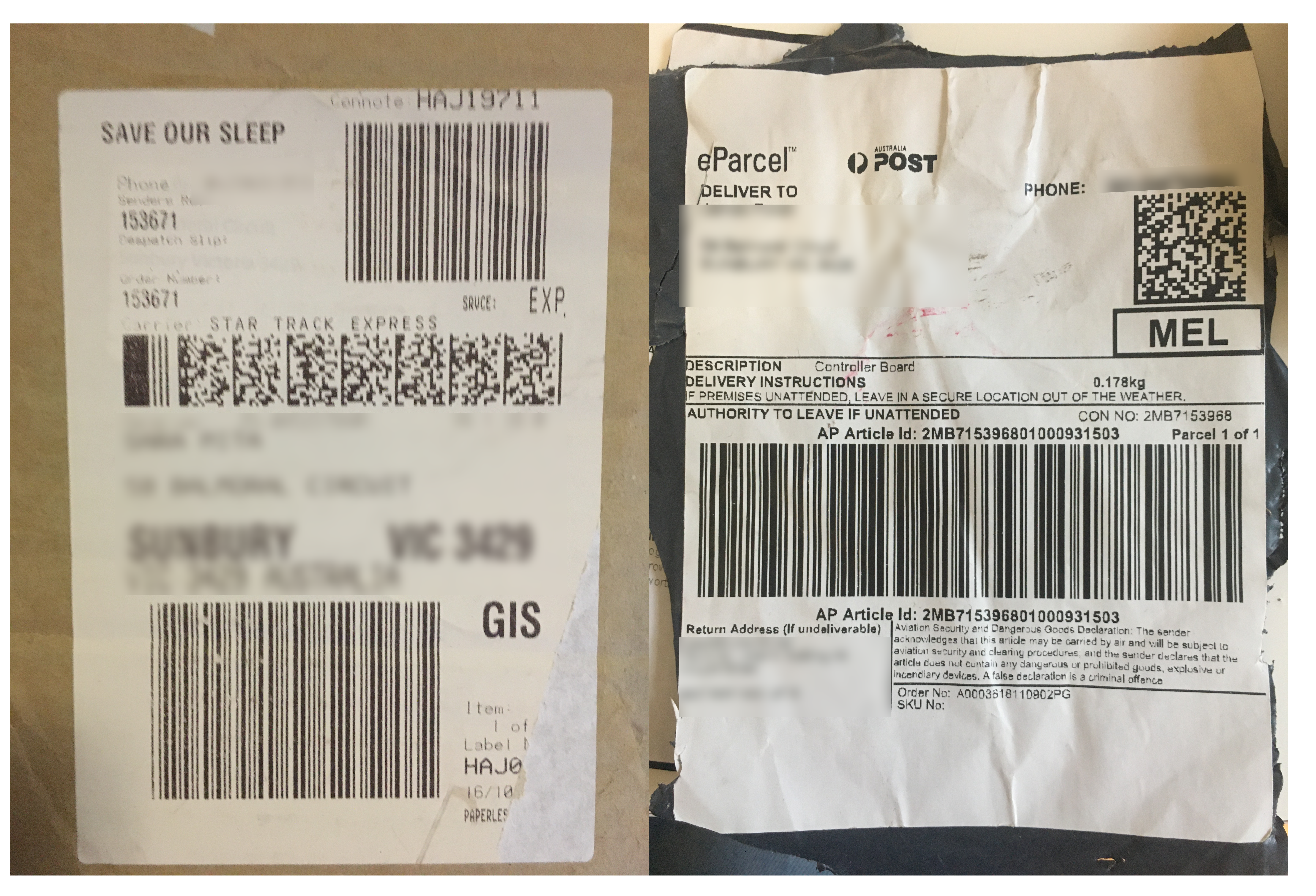
<p>Take a look at these two freight labels:</p>
<p><img src="/images/label_comp.png" alt="label comparison"></p>
<p>Both are from Australia Post. The one on the left is Star Track, and the one on the right is for the postal business.</p>
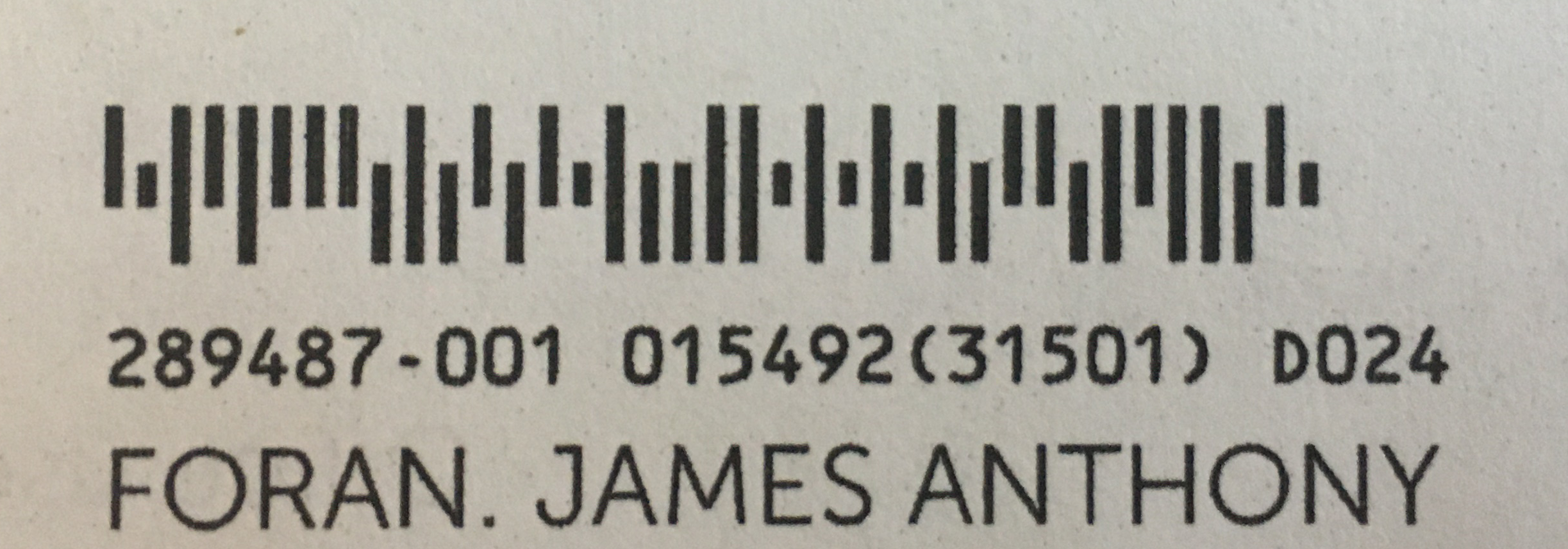
<p>These two formats are vastly different. I cannot work out how to read the StarTrack 2 dimensional code. If someone can give me more info on this, I would appreciate it! Please add your comments below.</p>
<p>So, labels even within a single organisation are not standard. I am sure Australia Post has different labels for international freight also. By why is there no standard?</p>
<p>The answer in this case is legacy systems. When Australia Post acquired StarTrack back in 2003, they also acquired all their technology, and label formats. These two divisions still primarily operate as separate networks.</p>
<p>One of the main reasons that these networks are not interoperable is label formats and scanning technology.</p>
<h2>Standard Labels</h2>
<p>So surely the answer is standard Label formats. There is an organisation GS1 have done exactly that. They have developed standard label formats, which companies can use. Unfortunately, these standards are still open to interpretation. For example, both Australia Post and Toll have implemented GS1 compliant freight labels, however, they are using different 2-dimensional barcode formats, meaning that you cannot route an Australia Post parcel through a Toll sort facility, and vice versa. We see this working with international post, as well as airline bagage very effectivly.</p>
<h2>So what?</h2>
<p>So why is this important? well, as our dependency on parcel networks continues to grow, our economy will become more and more reliant on the resilience and scalability of the parcel networks. These networks are under huge strain at the moment, seeing volumes being 4-5 times the average for this time of year due to COVID-19.</p>
<p>Earlier this year, we also saw the Toll parcel networks unable to operate automated systems, or even print labels, due to a systems outage that lasted weeks.</p>
<p>A nationwide standard label format would give more choice to customers, and improve efficiencies within the warehouse. It would also allow networks to scale, and provide real interoperability between parcel networks.</p>
<h1>The Future</h1>
<p>Will we see a consolidation of parcel networks? Will Australia Post become the only way to deliver parcels in Australia, similar to how it is the only way to deliver a letter?</p>
<p>I would love to hear your thoughts below.</p>

    ]]></content>
  </entry>
	
  
  <entry>
    <title>The life of a CON</title>
    <link href="https://flexion.tech/posts/the-life-of-a-con/"/>
    <updated>2020-03-23T02:35:00-00:00</updated>
    <id>https://flexion.tech/posts/the-life-of-a-con/</id>
    <content type="html"><![CDATA[
      <p>In our last post, we took a detailed look at <a href="./posts/confused-about-consignments/">what a transport consignment is</a>.  If you are not following this post, best read that one first. We compared a transport consignment to a sales consignment, and went into detail around what makes up a consignment.</p>
<p>In this post, we are going to take a look at the life of a consignment from creation, to settlement.</p>
<div class="zoom">
      <img class="zoom__img" src="/images/box-con.svg" alt="convict behind bars">
</div>
<h3>In this article</h3>
<ul>
<li><a href="#heading-conception-draft-consignment-creation">Draft Consignment Creation</a></li>
<li><a href="#heading-naming-ceremony-making-things-official(ish)">Freight label Generation</a></li>
<li><a href="#heading-tying-the-knot-goods-pickup">Goods Pickup</a></li>
<li><a href="#heading-Manifesting">Manifesting</a></li>
<li><a href="#heading-in-transit">In Transit</a></li>
<li><a href="#heading-deliver-us-from-evil">Delivery</a></li>
<li><a href="#heading-payment-and-settlement">Payment</a></li>
<li><a href="#heading-take-away">Take-away🥡</a></li>
</ul>
<h2>Conception - Draft Consignment Creation</h2>
<p>So where do consignments come from? It is a bit different to the reproductive systems we see in nature, where parents come together to create offspring. In the case of a consignment, we start with the offspring, and here, the offspring, are our freight items (aka the goods).</p>
<p><img 
class="width-half pad-top-800" 
src="/images/open-box.svg" 
alt="Empty box" 
loading="lazy"></p>
<p>Freight items that share certain attributes, can be grouped together into a consignment. Lets review some of the key attributes which must match for items to be grouped together into a consignment:</p>
<ul>
<li>
<p>Origin/Source - Where are the goods being shipped from. Seems simple, enough, and often it is. But lets take a quick look at 2 use cases, to make this really clear!</p>
<ol>
<li>Take the example of an online shopping cart. You have purchased 2 different items from a large online retailer, and paid for them in a single transaction. Those items however, are coming from two different source locations. These could be two warehouses, or, even 2 different suppliers. In this case, 2 consignments will be created.</li>
</ol>
</li>
<li>
<p>Destination - The delivery address. Freight items being dispatched from the same origin, but delivered to different locations, each get their own consignment. They will likely be picked up together, but these freight items will be grouped into a <a href="https://en.wikipedia.org/wiki/Manifest_(transportation)">manifest.</a> We touch on manifests a bit latter in this article.</p>
</li>
<li>
<p>Pickup Date - The date the freight items/goods are actually picked up. This scenario is best highlighted with a few examples:</p>
<ul>
<li>
<p>You have purchase 5 items from a specialty online retailer, and one of those items is not available for dispatch today.  the retailer contacts you, and asks if you want to wait until the other goods arrive in their warehouse, before dispatching.</p>
<ol>
<li>You decide to wait and get the goods shipped together. This means the goods will all be dispatched together, on a single day. 1 consignment will be created. The goods may all travel in the same freight item (box, carton etc), or make up separate freight items. In this case, a single consignment is created. Good for the retailer, as they only have to pay for a single base charge, but you will have to wait a bit longer for all your items to be delivered.</li>
<li>You want the items that are available delivered immediately. They are dispatched together, and a single consignment is created for those items. A week later, the other items arrive in the warehouse, and they are dispatched. A second consignment is created.</li>
</ol>
</li>
<li>
<p>I have starting to see some complex examples, where a distribution center is delivery items to stores, multiple times a day. In this case, the shipper wants to group freight items by pickup date, because this reduces their costs, ie, only a single base charge is applied for two different pickup activities. This can be at the expense of accurate tracking though. Commercial agreements between the shipper and transport providers drive how these rules are implemented. Also, restrictions on either side may mean you solve it in the shipper system, or, in the transport provider system.</p>
</li>
</ul>
</li>
<li>
<p>Service Type - Different service types will attract different charges. A single consignment only have <strong>one</strong> service type. Therefore, if some goods have an express service, and others are standard, but they share all other attributes, it may still cost less to ship these on separate consignments (think <em>air</em>, vs <em>road</em>).  However, in some cases, grouping all the goods on a single express consignment may be cheaper.</p>
</li>
<li>
<p>Transport Provider - In the previous example, of air vs road, the shipper may have different agreements in place with different transport providers, depending on the service selected. When the transport provider is set, depends on who is making the decision on which transport provider to use. Delaying the assignment of a transport provider can cause operational issues in the warehouse, but it is possible.</p>
</li>
</ul>
<p>So you may be wondering, <em>do I even need a draft consignment?</em> My favourite answer to these types of question is, <strong>it depends</strong>! You may need a draft consignment when:</p>
<ul>
<li>There are multiple carriers and services being utilised each day.</li>
<li>You have orders trickling in throughout the day, for the same origin destination pair.</li>
<li>You allow customers to make changes to their orders right up until the transport provider picks up the freight.</li>
</ul>
<h3>Use case🔎 Car Parts Warehouse</h3>
<p>Let me illustrate with an example. Car Parts Warehouse (CPW) offers two services to customers. Their customers include mechanical repair shops. They allow the repair shops to order goods as they need them.  They also offer 3 delivery services: Next day afternoon. Next day before 9am, and same day.  The order cut-off for same day is 2pm.</p>
<ol>
<li>A mechanic is placing orders throughout the day. As they need parts, they go to the CPW website and add items to their order as needed. The service selected is next day by 9am.</li>
<li>The mechanic needs to place an urgent order, for a same day delivery for a single customer. they place the order for urgent parts @1:45pm, and agree to pay the premium price. They also decide to get all the parts delivered same day, as this will save them money for the extra delivery.</li>
</ol>
<h2>Naming ceremony - Freight Label Generation</h2>
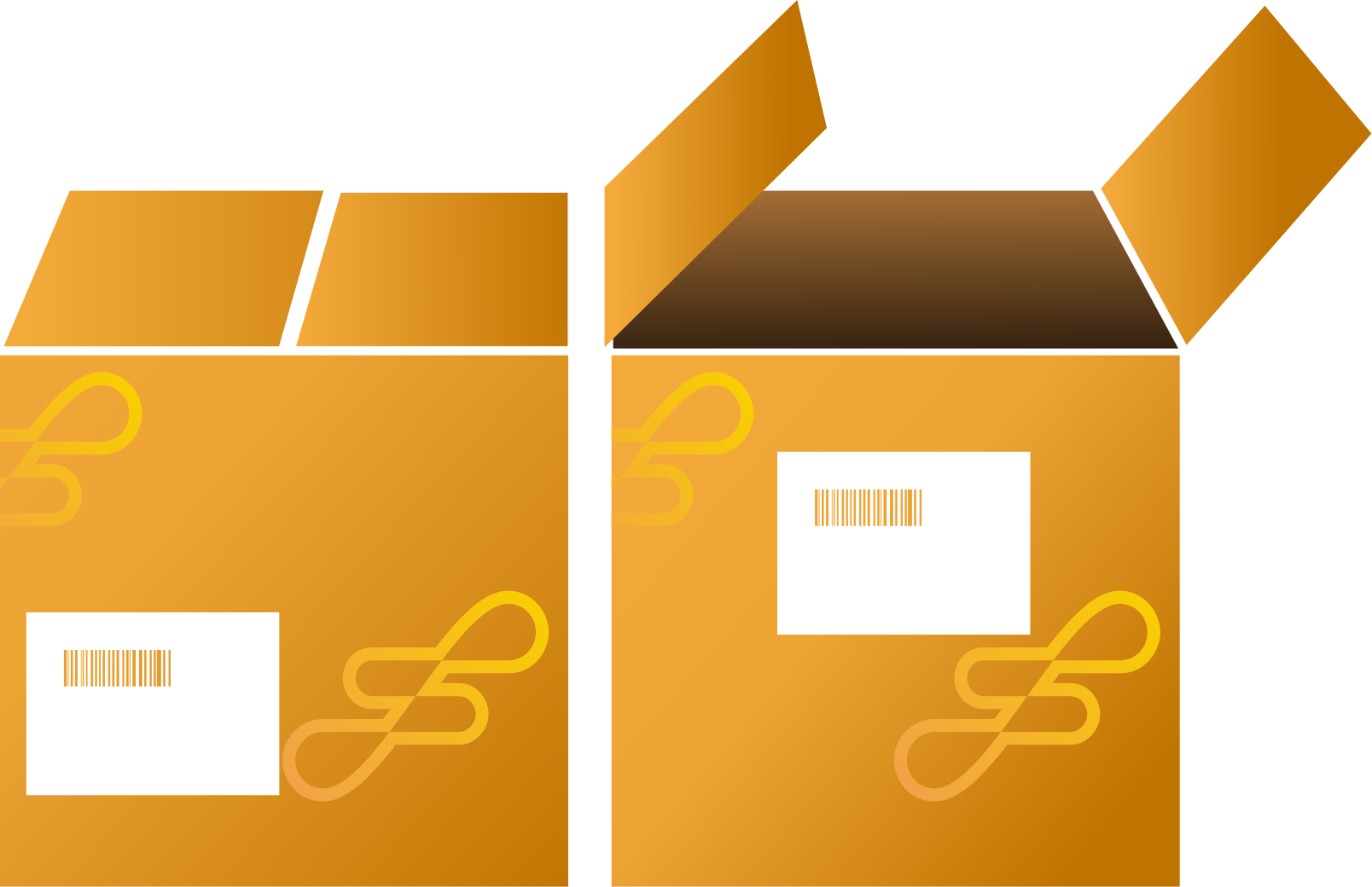
<p><img src="/images/box-open-box.svg" alt="Open box, closed box with labels attached"></p>
<p>We now have a draft consignment and we have a box containing the goods and we want to close the box. At this point, we have to label the boxs or goods directly, so the transport provider know where to send it. What do we need to do to allow this to happen?</p>
<blockquote>
<p>🏷Label it! If we close the box, with the picking list inside, without first putting a label on the box, things might get a little confusing when the driver comes to pickup the freight!</p>
</blockquote>
<p>To generate a label, we first need to know who the Transport Provider is. Next, Consignment Numbers need to be generated. These numbers are mostly specific to a Transport Provider.. Each Transport Provider will also have a specific label layout. These labels allow goods to be automatically <strong>and</strong> manually sorted, and of course delivered.  I could write all day about consignment numbers.... but I wont go down that 🐰🕳 today.</p>
<p>So, we have now stuck a label on a box! Our consignment is ready to be picked up. The label will tell us:</p>
<ul>
<li>Destination</li>
<li>Service type</li>
<li>Consignment Number &amp; bar-code (1D and/or 2D)</li>
<li>Item Number &amp; bar-code (1D and/or 2D)</li>
<li>Optional:
<ul>
<li>delivery instructions</li>
<li>🧨Dangerous Goods (DG) information.</li>
</ul>
</li>
</ul>
<p>At this point, you are still able to print new labels as you need, and create new freight items (boxes etc) to be added to the consignment, as long as they conform to the rules we discussed above.</p>
<p><em>Note</em>, for pre-paid consignments such as satchels, this is generally not possible.</p>
<h3>Use Case🔎 Car Parts Warehouse</h3>
<p>In our example, we would have to re-label the freight items, if they had already been labelled previously. At this point, as the transport provider has not picked up the goods, Car Parts Warehouse will not be charged at all by the original carrier.</p>
<h2>Tying the knot - Goods pickup</h2>
<p><img src="/images/knot.svg" alt="A knot in a rope"></p>
<p>The Transport provider has arrived, and is ready to pick up the freight items. Transport companies like to know what you are transporting, so they can send the appropriate vehicle. In our example, we have been talking about a single consignment, which is made up of a few boxes, or freight items.</p>
<p>But, in reality, for many businesses, a single pickup with be for multiple consignments, all going to different destination locations.  While the consignment is an critical for the final delivery of the freight, at the time of pickup, a manifest is required.</p>
<h3>Manifesting</h3>
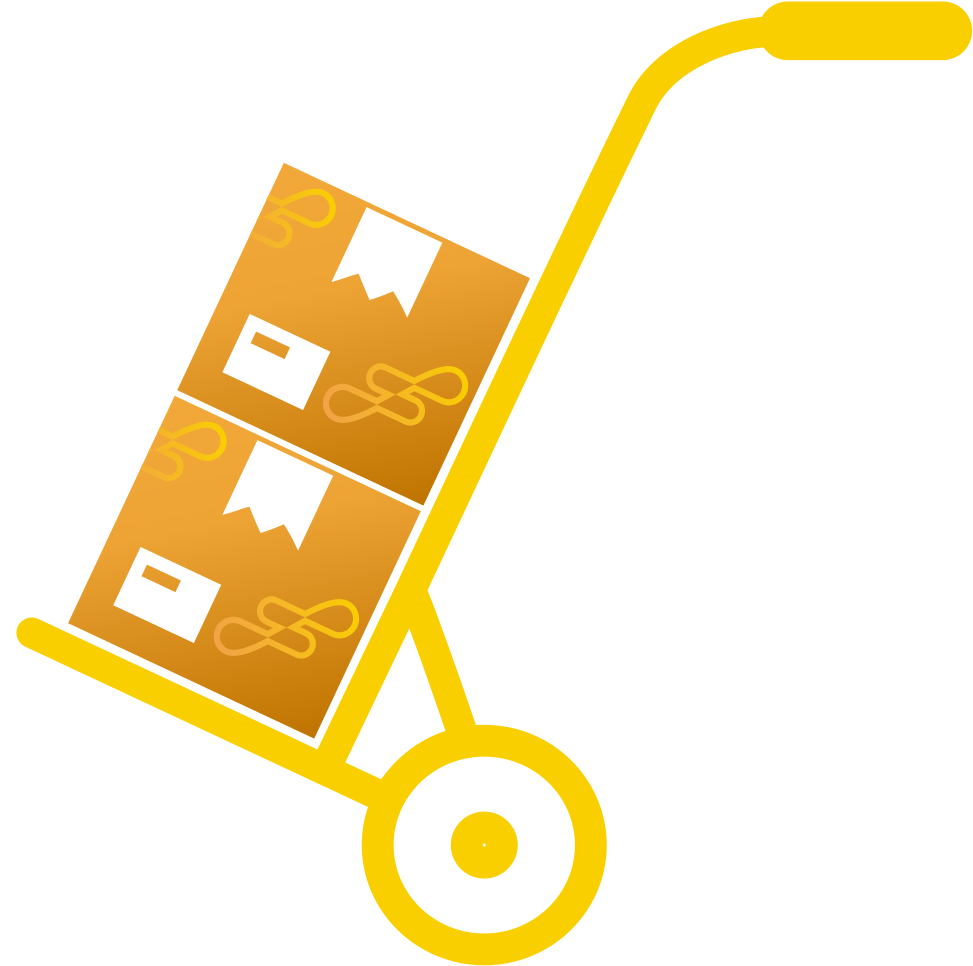
<p><img src="/images/trolley.svg" alt="boxes on hand trolley"></p>
<p>A manifest is a list of all freight items on a vehicle.  For each pickup a vehicle does, a manifest is required for all the freight being loaded onto the vehicle. Note, if Dangerous Goods are being loaded onto the vehicle, a separate manifest is required, which includes all the required hazardous goods information.</p>
<p>In most cases, a manifest will be all the freight items, that are loaded onto a vehicle. Ideally, each freight item will be scanned by the driver, to confirm the pickup, though this is not always possible.</p>
<p>It is critical that the Manifest accurately reflects all the freight items that are being loaded onto the vehicle. These documents may be used by the authorities when a vehicle is intercepted to validate the freight on board. It is also used as a record that the transport company has picked up the freight.</p>
<p><img src="/images/timer-target.svg" alt="A timer, target and check list"></p>
<p>This is also a critical milestone, as this is generally when the timer starts for the delivery of the freight. The consignment pickup date will be used to measure the transport providers performance, and set estimated time of delivery (ETD).</p>
<h2>In Transit 🚚</h2>
<p>The mysterious <em>&quot;in transit&quot;.</em> What really happens between when the goods are picked up, and when the arrive at their destination? Traditionally, this really has been a mystery, not just to shippers, but to transport companies also. The only mechanism we have today for knowing where freight is, is a scan of a bar-code, with a corresponding location. This will occur at automated sort, and sometimes freight will be scanned by the driver performing the final delivery. But what if the transport company that picked up the goods, is not the company that delivers the goods?</p>
<p>We are starting to see more and more transport companies provide more accurate <em>&quot;in transit&quot;</em> events, and improve visibility. We are now even starting to see real time tracking, via GPS, where the vehicle is tracked, and we know the freight is on a specific vehicle. This is pretty easy for point-to-point deliveries, however, when moving freight through complex networks, and utilising on-forwarders, and sub-contractors, things get pretty difficult.</p>
<h3>Dimension and weight</h3>
<p>Accurate dimension and weight information are critical for transport companies. Shippers may not provide accurate information, if they provide any at all. More often than not the rates are based on weight and dimensions of the freight items. Transport companies will either have automated processes for capturing this information. This information will be updated against the consignment, to ensure the correct rates are applied.</p>
<h2>Deliver us</h2>
<p>For the transport company, this is by far the most important step, for the simple reason, that this is where they collect the proof that they have delivered the freight, and at which point they can accurately charge the customer.  This proof comes in the form of a <em>&quot;proof of delivery&quot;</em> document, or, a <strong>POD</strong>.</p>
<p>This POD should be recorded for each freight item, not simply just the consignment. There are many circumstances where freight items that belong to a single consignment will be delivered on different days. The more complex the transport networks, the more likely this is to happen.</p>
<h2>Payment 💰 &amp; Settlement</h2>
<p>This is where everything has to come together to ensure customers receive an accurate invoice, and the transport providers are appropriately compensated for the services they have provided. Providing POD is accurate, and there are no disputes around the dimension and weight, the shipper will pay for the transport services provided.</p>
<p>In other cases, payment is made up-front or may be pre-paid, as is the case with many postal satchel services. In these cases, updates to dimension and weight information can result in additional charges being applied, either after delivery, or prior to pickup.</p>
<h2>Take Away 🥡</h2>
<p>As you can see, the humble consignment is quite a complex beast.</p>
<p>Having the right systems and processes in place to support all the use cases that your business encounters when transporting freight is critical, and with today's digitisation, and increasing demands such as real time tracking, this is becoming more important than ever.</p>
<p>Are you struggling with consignments too? Let us know in the comments below! We would love to hear from you! and if you want to get regular updates via email, please <a href="#subscribe">subscribe</a> below.</p>

    ]]></content>
  </entry>
	
  
  <entry>
    <title>Confused about Consignments?</title>
    <link href="https://flexion.tech/posts/confused-about-consignments/"/>
    <updated>2020-03-16T23:34:00-00:00</updated>
    <id>https://flexion.tech/posts/confused-about-consignments/</id>
    <content type="html"><![CDATA[
      <p>Consignments are a critical part of the transport industry. But over the years I have found that they have been the source of much confusion, often on my part! In this post, I will detail my understanding of consignments, and why they are critical to the logistics industry.</p>
<p>In this article:</p>
<ul>
<li><a href="#heading-what-is-a-consignment">What is a Consignment</a></li>
<li><a href="#heading-why-do-we-need-consignments">Why do we need Consignments</a></li>
<li><a href="#heading-structure-of-a-consignment">Structure of a consignment</a></li>
<li><a href="#heading-up-next">Up Next</a></li>
</ul>
<h2>What is a Consignment</h2>
<img class="width-third pad-top-800" src="/images/flexion-box.svg" alt="Flexion delivery box" loading="lazy">
<p>It might seem a simple question. Before I got into logistics, consignment to me meant selling goods &quot;on Consignment&quot;, which basically meant that goods could be placed on sale in a store, without the store having to ever take ownership of the goods. Once the goods have been sold, then the retailer pays the seller for the goods.</p>
<p>The term consignment is also used when transportation of goods using a third party. The company responsible for the transport of the goods does not have to purchase the goods in order to transport them. Similar to when goods are &quot;on Consignment&quot;, they are acting as an intermediate party between the seller and the buyer.</p>
<h3>Confusing use case</h3>
<p>Lets say you make hand knitted blankets, and you sell them at a local retailer. The retailer they display your beautify blankets in the window. When the retailer sells some of your blankets, they pay you for the sold items, and they may order new stock from you.</p>
<p>Now you have a new retailer wanting to stock your goods on consignment. But they are in Sydney, while you live in Adelaide (about a 14 hour drive!). You now need to engage with a transport company to transport the goods to Sydney. You now need to consign the goods to the transport company, who will transport the goods to the Sydney retailer.</p>
<h3>Consignor</h3>
<p>The Consignor is the person who consigns the goods, or, sends the goods. They may also be called the shipper. In the above example of the knitted blankets, the maker is the consignor in both cases.</p>
<h3>Consignee</h3>
<p>That leaves us with the consignee. So who in the above example is the consignee? For the first example, where we are dealing with a sales consignment , the retailer is the consignee. However, when talking about a transport consignment, the receiver of the goods is the consignee. Now as it happens, in the above example, this is also the retailer and not the transport company.</p>
<p>To further illustrate, lets take another example, where you have purchased something from the <a href="https://www.buyfromthebush.com.au/artandcollectables">#buyfromthebush</a> site, to support communities devastated by bush fires. When you purchase the goods, the consignor is the seller of the goods, and the consignee is you, the customer. The importance of this will become apparent when we look at the lifecycle of a consignment later on.</p>
<h3>Also Known As</h3>
<p>A Consignment may not actually be referred to as a consignment, for various reasons. It may often be referred to as a shipment, or job, depending on the transport company you are dealing with. When it boils down to it though, they are pretty much all the same thing.</p>
<h3>Similar Too</h3>
<p>I have also been on projects where it is called a Connote, which is short for Consignment Note. Note, this is not a consignment. A consignment note is actually a document which travels with the goods being shipped,and provides proof that the carrier has received the goods.</p>
<p>A consignment is also similar to a way-bill, or a house bill. While these are very similar to a consignment, they contain additional information including terms and conditions, and potentially route information also.</p>
<p>A <a href="https://en.wikipedia.org/wiki/Bill_of_lading">bill of lading</a> is another similar term, however, this is a legal document confirming the receipt of goods by the carrier, particularly in global logistics. This is a topic for another post though.</p>
<h2>Why do we need Consignments</h2>
<p>Before getting into the structure of a consignment, and the life cycle of a consignment, I think it is best to understand what a consignment is used for in the transport industry. This will help with understanding why a consignment is different to a shipment, transport request or item (both will be covered in future articles).</p>
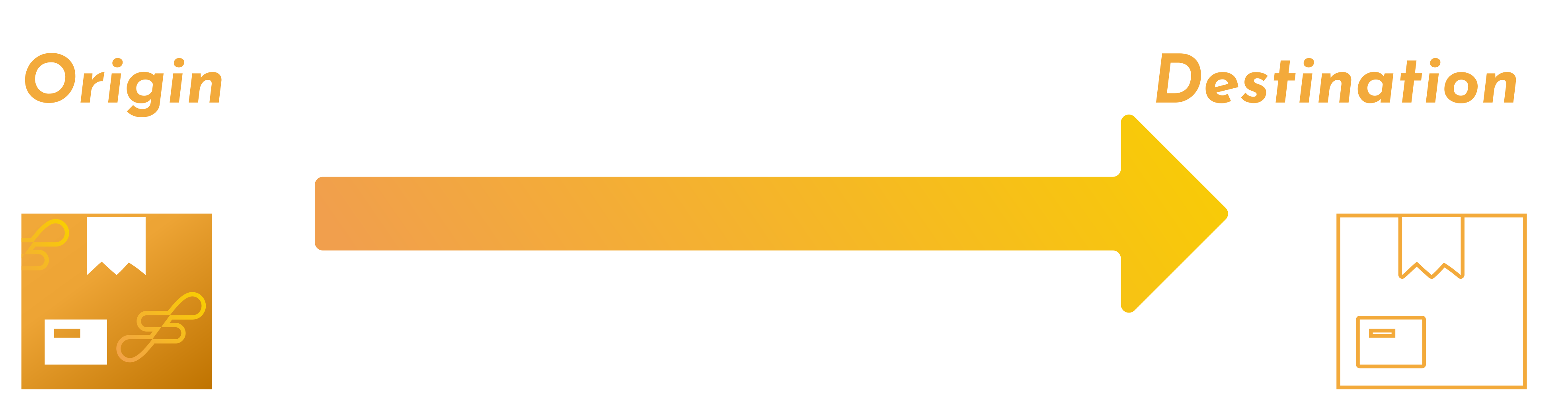
<p><img src="/images/origin-dest.svg" alt="parcel goes from origin to destination"></p>
<p>A transport consignment is required to store relevant information against it, to ensure that the transport provide is able to accurately calculate rates, and provide evidence to the consignor, that the goods have been delivered to the consignee.</p>
<h2>Structure of a Consignment</h2>
<p>For a consignment to be useful, it must contain information that ensures we can:</p>
<ul>
<li>calculates rates - Quote and Final</li>
<li>Details of the goods being shipped</li>
<li>Details that will enable the transport provider to pick-up, and deliver the goods.</li>
<li>Enable financial settlement</li>
</ul>
<h3>Base Information</h3>
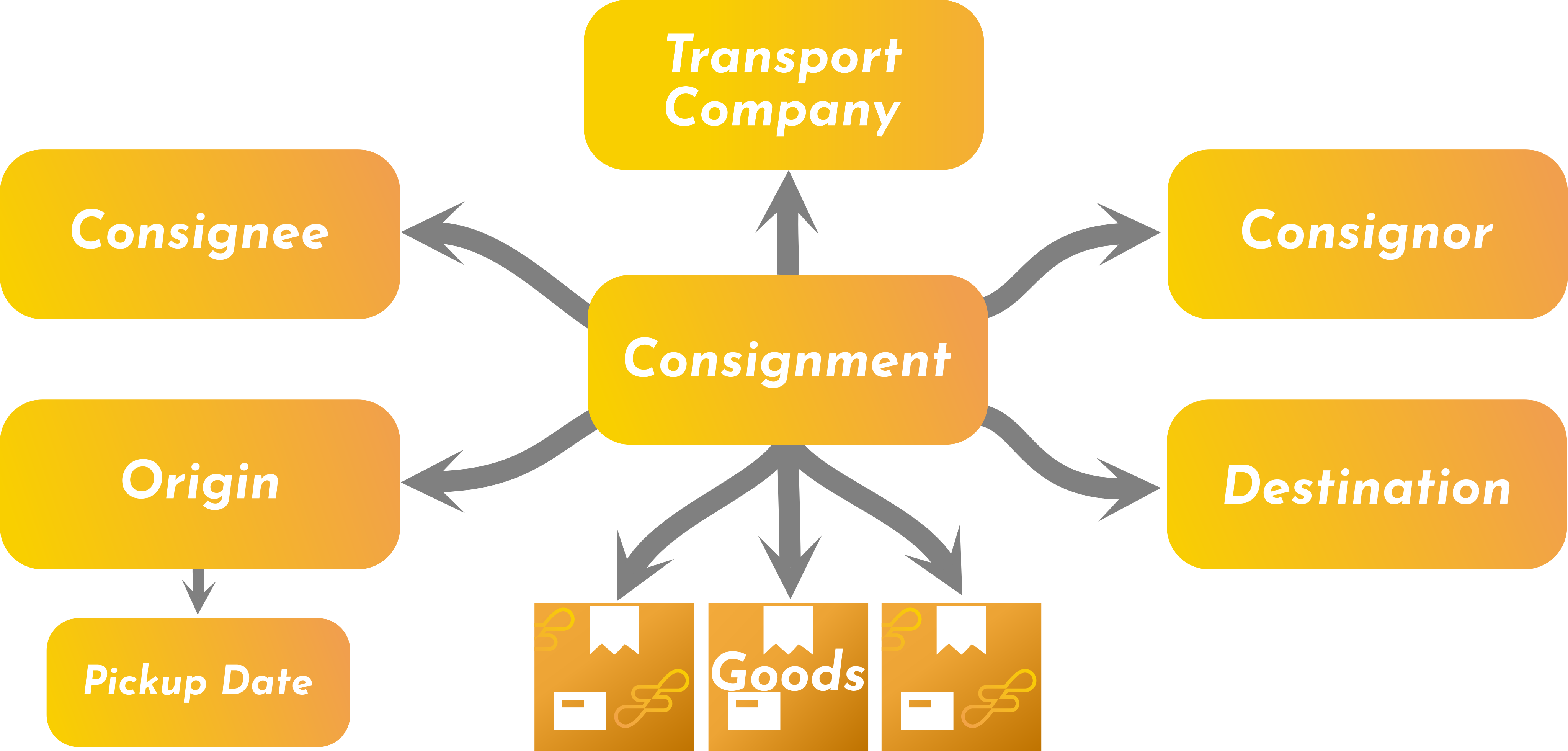
<p><img src="/images/consignment-structure.svg" alt="Consignment and related information"></p>
<p>Each consignment, must have one of each of the following, with the exception of goods.</p>
<ul>
<li><strong>Consignor</strong> - The shipper.</li>
<li><strong>Consignee</strong> - The receiver.</li>
<li><strong>Origin</strong> - Where are the goods being picked up? May or may not be the consignor.</li>
<li><strong>Destination</strong> - Where are the goods being delivered? May or may not be the consignee.</li>
<li><strong>Goods</strong> - Details of the things being delivered. 1 or more of these will generally be attached or lined to a consignment. Moving forward, we will refer to this as <strong>freight item</strong>, to try to avoid confusion. <em>Note</em>, this does not talk about the products, rather, what the products are being carried in or on. In other words, what is being physically handled by the transport operators. Each freight item must be individually labelled.</li>
<li><strong>Transport Provider</strong> - The organisation responsible for the pickup and delivery of the freight items.  The transport provider may utilise other 3rd party providers for part or all of the tasks associated with the movement of the freight items.</li>
<li><strong>Consignment Number</strong> - A number used to help identify the consignment, and the associated freight items. Often, these numbers are specific to the transport provider, but in some cases, large shippers will insist on using their own identifiers.</li>
<li><strong>Pickup date</strong> - When <em>were</em> the freight items actually picked up. All of the freight items should be picked up on the same day, to form a consignment. This date is used for applying the correct rates and determining billing periods. If freight items are picked up on separate days, then this should result in two consignments.  <em>Note</em>, freight items can be delivered on different days, and still be part of the same consignment.</li>
</ul>
<h3>Additional information</h3>
<ul>
<li><strong>Service Type</strong> - For example,  express, or standard. This will impact the transit time, and also the cost of the consignment.</li>
<li><strong>Mode of Transport</strong> - Is a specific mode being selected? For example, rail or road. Again, this will impact the delivery date, and the cost.</li>
<li><strong>Requested Pick-up date and time</strong> - When will the freight items be available for pick-up at the origin location. Shippers don't want the transport provider arriving at the pick-up location before the goods are ready for dispatch.</li>
<li><strong>Delivery date and time</strong> - When do the freight items need to be delivered to the destination. Different delivery dates may drive the selection of service and/or transport mode.</li>
<li><strong>Pick-up/Delivery Instructions</strong> used to help the driver complete their task. May be as simple as an <em>authority to leave</em>, to a <a href="https://en.wiktionary.org/wiki/mud_map" title="A rough drawing">mud-map</a> for a construction or mine site.</li>
</ul>
<img class="width-half right" src="/images/package-front-door.svg" alt="Package at front door" loading="lazy">
<ul>
<li><strong>Hazardous information⚠</strong> - Can effect the cost, selection of service, and also what other freight items can travel with this consignment.</li>
</ul>
<p>All this information is used by the transport provider, to enable them to provide a service that is efficient and safe.</p>
<h2>Up Next</h2>
<p>In our next article, we will look at the life cycle of a consignment, and some more complex use cases, which might impact how you need to work with consignments. Things vary greatly depending who you are. A shipper will have different requirements to a transport provider, and transport providers may be operating as a 2PL, 3PL, 4PL or a combination of all, which makes for some really challenging scenarios.</p>
<p>If you have anything you think should be added to, or corrected in this article, please comment below, and if you want to get our latest content delivered via email, please subscribe to our <a href="./#subscribe">newsletter below</a>.</p>

    ]]></content>
  </entry>
	
  
  <entry>
    <title>Forming New Opinions</title>
    <link href="https://flexion.tech/posts/forming-new-opinions/"/>
    <updated>2020-03-14T13:00:00-00:00</updated>
    <id>https://flexion.tech/posts/forming-new-opinions/</id>
    <content type="html"><![CDATA[
      <p>In this article:</p>
<ul>
<li><a href="#heading-accessibility">Accessibility</a></li>
<li><a href="#heading-jamstack">JAMStack</a></li>
<li><a href="#heading-progressive-enhancement">Progressive Enhancement</a></li>
<li><a href="#heading-email-subscription-service">Email Subscription Service</a></li>
</ul>
<p>Now that the basic flexion.tech website up and running and we are getting ready to start posting regular articles, I realised it was time to add a subscription option to this site.</p>
<p>The aim here is to not rely on LinkedIn and Twitter to connect to my audiences in the future. These are really valuable platforms, particularly LinkedIn for me, however, it is preferred to connect directly with people who are interested in the content published here, and of course, I want to retain ownership of my content!
<img class="pad-top-500 width-half" src="/images/flexion-email.svg" alt="flexion letter in envelope"></p>
<p>There are many options out there for adding forms to websites, but I wanted to ensure <em>flexion.tech</em> is adhering the following:</p>
<ul>
<li>JAMStack principles</li>
<li>loosely coupled architecture</li>
<li>Avoid external dependencies</li>
<li>Progressive Enhancement</li>
<li>Accessibility</li>
</ul>
<h2>Accessibility</h2>
<p>So is Accessibility a strange place to start? Absolutely not! If you want your site to be accessible, starting here will make your decisions much easier. If you have accessibility as one of your core principles from the start, simple decisions now avoid inaccessibility issues later on.</p>
<p>Lets take a quick example. what if you were building a retail store, and only designed the store for people who were able to walk, you may utilise steps, and your store layout may prevent people who are in wheelchairs from navigating the store easily. What if instead, you designed store with wheelchair access in mind. You avoided use of steps throughout, and you utilised ramps where required. This may even effect your selection of a location to build the store.</p>
<p>Now, your store is a much better experience for people who cannot walk, and also those caring for people who cannot walk. If you think this is not you, think again. We are all born unable to walk, and for the first few years we are pushed around in prams, which are really just small wheelchairs. And at some stage, many of your customers may have restricted mobility, via broken legs, operations, etc.</p>
<p>Imagine if you build a retail store, or had to renovate an existing one after the fact, to enable accessibility? It is going to be a very difficult, and expensive process.</p>
<p>There are many great resources on the web on the topic of accessibility on the web. <a href="https://a11yproject.com/">A11y Project</a> is an amazing resource, and if you are into podcasts<a href="https://a11yrules.com">a11yrules</a> is a great listen.</p>
<p>One of the key takeaways for me was to start with <a href="https://en.wikipedia.org/wiki/Semantic_HTML">semantic markup</a>, which basically means, use standard HTML elements, like FORM and INPUT and BUTTON, rather than DIV and SPAN.</p>
<p>I am still new to this, but I will eventually start to test my site with a screen reader, to get a better understanding of how vision impaired people experience the web.</p>
<h2>JAMStack</h2>
<p>As flexion.tech is already aligned well to JAMStack principles, and I am hosting it on Netlify, the company that coined the term JAMStack! I was able to find a pretty simple solution for getting my semantic HTML processed as Netlify comes with a pretty handy solution here. By adding a few attributes to the HTML markup, I was able to get a form up and running in a very short amount of time. I did experience <em>some</em> issues here on my site though. More details on that later.</p>
<p>For a great article on getting things setup, head over to CSS Tricks and read <a href="https://css-tricks.com/using-netlify-forms-and-netlify-functions-to-build-an-email-sign-up-widget/">this article by Matthew Strom.</a></p>
<h3>No localhost support</h3>
<p>The Netlify forms do not work when developing locally. I am aware there is a solution to run <a href="https://www.netlify.com/products/dev/">Netlify locally</a>, but I was not ready to go down this path just yet.</p>
<p>Another feature if Netlify comes to the rescue here, and that is Deploy Previews. Netlify can be configured to deploy all, or selected branches, from your github repo.</p>
<h2>Progressive Enhancement</h2>
<p>With the use of Netlify Forms, which requires no client-side JavaScript, it was pretty simple to implement progressive enhancement. I am still learning about this, but basically, theway I have approached it is as follows:</p>
<ul>
<li>HTML loaded only (no JavaScript and no CSS). The form should still work, even if it is not that pretty. I am thinking this should also help with accessibility also in some way. Do this first!</li>
<li>HTML + CSS. Form should be pretty now, and function correctly. This is the case, but when the form is submitted, it redirects to a thank-you page.</li>
<li>HTML + CSS + JavaScript. The form is submitted, but rather than redirecting to thank-you page,  the form section is replaced with a thank-you message.</li>
</ul>
<p>So, build the HTML first, then add CSS, and finally JavaScript, testing each step of the way. I actually think this is a faster way to develop, especially when starting from scratch.</p>
<h3>Headaches</h3>
<p>In developing this way, I ran into a frustrating issue. When JavaScript was enabled, I was getting an error in the browser, when the form was submitted. My struggles are documented in detail on the <a href="https://community.netlify.com/t/form-submission-working-but-action-path-is-not-working/9902/11">Netlify Community page.</a></p>
<p>I reached out to <a href="https://twitter.com/hankchizljaw">Andy Bell</a> who thankfully put me in contact with <a href="https://twitter.com/davebeesley">Dave Beesley</a> who had experienced a similar issue. Some changes to the Service-Worker cache settings looks to have resolved this issue! Thanks Twitterverse!</p>
<p>All looking good now. The only concern I have remaining is a false positive test, which I have not been able to reproduce! Basically, someone subscribed, got the success message, but nothing made it to Netlify Forms. This one will be hard to monitor. If you are reading this, please give it a test below. If you do not get an email from me within a few minutes (please check your junk email too), please let me know!</p>
<h2>Email Subscription Service</h2>
<p>So, with the first half working, the next part was to integrate to an email marketing service. Here, I chose the path of least resistance, and decided to use Zapier, at least for now, to integrate Netlify Form data, with MailChimp.</p>
<p>This was really the easiest part. <a href="https://zapier.com/">Zapier</a> is a breeze to setup, and the UI is really intuitive, and quite fun to use. The developers there have managed to build quite a bit of personality into the platform, and most importantly, it just works!</p>
<p>MailChimp on the other hand was not really agreeing with me.</p>
<h3>ConvertKit</h3>
<p>I recently subscribed to <a href="https://overreacted.io/">Dan Abramov 's</a> site, and received a series of emails about JavaScript. What I loved about these emails was, they were just emails. I could read them in the email client, and there was not strange formatting, click bait, or that sort of thing. It felt really personal. Plus the content was <strong>amazing</strong>. Something I really want to emulate with my email marketing.</p>
<p>So, I made the switch... And thanks to the loosely coupled architecture, it was again pretty damn simple. Create an ConvertKit account, update the Zapier ZAP, and boom💣, away we went!</p>
<p><img src="/images/subscriber-list.png" alt="netlify, zapier and convertkit logo"></p>
<h2>Next Steps</h2>
<p>Now with all that setup, it is time for me to focus on creating new content for the site. In future the site will ideally move away from Netlify Forms and Zapier, and build an custom API which takes the form input, and sends it to ConvertKit.</p>
<p>The reasoning behind this is to ensure the best possible user experience.  As it stands today, if a user subscribes twice, the workflow exactly the same. Ideally, I want to tell the user if they have already subscribed and give them the option to resend a confirmation email. Testing has been really good on the ConvertKit API's so far, and I am confident I can get the above working while still align to the principles listed above.</p>
<p>Another minor issue is that the form continues to appear after someone has subscribed. I think the only way to resolve this is by using cookies, and I really think adding more complexity to the website just to hide the subscription form is not worth it. That is why the form is at the bottom of the page. I will see what the user feedback is. If anyone has advice on this, please let me know below in the comments section.</p>
<p>And of course, please subscribe for regular updates via email!</p>

    ]]></content>
  </entry>
	
  
  <entry>
    <title>AI is coming, are you ready?</title>
    <link href="https://flexion.tech/posts/ai-is-coming/"/>
    <updated>2020-02-23T04:40:00-00:00</updated>
    <id>https://flexion.tech/posts/ai-is-coming/</id>
    <content type="html"><![CDATA[
      <p>In this article:</p>
<ul>
<li><a href="#heading-blue-yonder">Blue Yonder</a></li>
<li><a href="#heading-digitisation">Digitisation</a></li>
<li><a href="#heading-freight-tracking-evolution">Freight Tracking Evolution</a></li>
<li><a href="#heading-ai-example-use-case">AI Example Use Case</a></li>
<li><a href="#heading-removing-unnecessary-complexity">Removing Unnecessary Complexity</a></li>
<li><a href="#heading-takeaways">Takeaways</a></li>
</ul>
<h2>Blue Yonder</h2>
<p><img src="/images/blue-yonder.svg" alt="Blue Yonder Logo"></p>
<p>Last week there was a major announcement that JDA is re-branded to <a href="https://blueyonder.com/">Blue Yonder</a>.</p>
<p>In 2018, JDA purchased BlueYonder, a data science based company that was utilising AI and ML algorithms to help organisations make better supply chain decisions, with the promise if improved efficiencies.</p>
<p>With the re-branding, we will now see the focus shift completely to be marketing the powers of AI and ML. It says a lot about the impact this tech is having on the logistics industry, even if it is just marketing impact for now.</p>
<p>We are yet to see if/how this technology will be used to enhance <a href="https://french.jda.com/solutions/detail/transportation-management">JDA TMS</a>, however, with the re-branding of JDA to Blue Yonder, we can be assured that there will be some interesting developments in the years to come.</p>
<p>But what will they be, and how can you get ready for them today? There is much that can be done today, to get ready for the coming wave of AI and ML. As the old saying goes, failing to prepare, is preparing to fail, and in the AI space, it seems <a href="https://www.gartner.com/en">Gartner</a> think failure is even more likely, with the bold prediction that <a href="https://www.bmc.com/blogs/cio-ai-artificial-intelligence/">85% of all AI projects will &quot;not deliver&quot; for CIO's</a>.</p>
<h2>Digitisation</h2>
<p>For many businesses, realising the benefits of AI technology is years off. But it will be critical for companies to ensure they have the correct foundations in place, to take advantage of AI and ML in the years to come. <a href="https://towardsdatascience.com/data-scientist-the-dirtiest-job-of-the-21st-century-7f0c8215e845">It is said</a> that data scientists spend only 20% of their time on algorithms, and the rest is spent preparing and cleaning up data.</p>
<p>Digitisation is a word that gets used a lot in the IT industry. Companies who have higher levels of maturity in the digitising their processes will be best placed to take advantage of AI. But what exactly does digitisation mean? Basically, it just means, turning information into an electronic format. Wiki says:</p>
<blockquote>
<p>Digitisation means converting information into a format that can be processed by a computer.</p>
</blockquote>
<p><img src="/images/flexion-digitised-logo.png" alt=""></p>
<h2>Freight Tracking Evolution</h2>
<p>Digitisation though is not a binary step. it takes place in stages, and evolves over years, and decades. Lets take freight tracking as a example, and look through the some of the stages of digitisation we have seen over the decades.</p>
<ol>
<li>Bar-codes are added to manual consignments, to allow for scanning within freight facilities. Bar-codes only started to be used in supermarkets in around 1974. They are now on every product we purchase, and every item, package, box and pallet that moves through the supply chain.</li>
<li>In the 90's, with the advancements in mobile communication, drivers are provided with <a href="https://en.wikipedia.org/wiki/Mobile_data_terminal" title="Mobile Data Terminal">MDT's</a> to receive pick-up instructions, and also to enable consignment scanning at pick-up and delivery points. This also enabled generation of electronic <a href="https://en.wikipedia.org/wiki/Proof_of_delivery" title="Proof Of Delivery">POD</a>.</li>
<li>As the internet finds its ways into the majority of businesses and warehouses, consignments labels are generated for each item at the despatch location , removing the need for manual data entry for billing purposes, allow for partial POD's and item level freight tracking.</li>
</ol>
<h2>AI Example Use Case</h2>
<p>Lets look at an example use case where an organisation is wanting to take advantage of AI to enable forecasting for the number of drivers required to execute deliveries in the afternoon, and provide accurate ETA's to customers. Tee inputs into the algorithm could potentially be the following(although more would likely be needed):</p>
<ul>
<li>
<p>Historical consignment data</p>
</li>
<li>
<p>Consignment data (destination info)</p>
</li>
<li>
<p>Consignment item details, including current location</p>
</li>
<li>
<p>customer forecasts</p>
</li>
<li>
<p>environmental forecasts</p>
<ul>
<li>weather</li>
<li>traffic</li>
</ul>
</li>
<li>
<p>Driver capabilities - vehicle capacity</p>
</li>
</ul>
<h3>Potential Issues</h3>
<p>Lets take a quick look at some of the potential issues a project of this complexity might face.</p>
<h4>1. Manual procedures</h4>
<p>Even though your organisation has digitised much of its operations, it still has long standing customers who are not able to provide consignment data electronically in time for the AI algorithms to run, and decisions to be made.</p>
<p><strong>Possible resolution</strong>: Allow for this &quot;unknown&quot; quantity in the algorithm, and utilise historical data to forecast consignment data</p>
<h4>2. External dependencies</h4>
<p>The algorithms accuracy is now dependent on the availability of information from many sources. Any delay in receiving information will effect the accuracy of the forecast.</p>
<p><strong>Possible resolution</strong>: Build in fall-back options for every data source and enable user input for external figures</p>
<h4>3. Missing parameters</h4>
<p>If the algorithm does not include critical parameters that have an impact on the number of drivers needed, the accuracy of the system will not be trusted by operational personnel, and the system will not be used.</p>
<p><strong>Resolution</strong>: AI algorithms must be designed <strong>with</strong> operational people. This is a huge change management challenge, as these systems are seen as a threat. People will hold onto critical information if they are not part of the solution.</p>
<h4>4. Scale</h4>
<p>For potential benefits to turn into real benefits, appropriate scale must exist to ensure that the costs of implementation are lower than the savings to be realised by the organisation.</p>
<p><strong>Resolution</strong>: Engage with experts with a proven track record in the logistics industry, as well as your geography.</p>
<h4>5. Unnecessary Complexity</h4>
<p>Complexity come in many forms. If you are utilising multiple internal systems to capture consignments for example, or customer forecasts are in different formats, this added complexity will mean data scientists will first have to interpret and standardise data before the AI algorithms can run.</p>
<p><strong>Resolution</strong> Remove complexity where possible. Not doing so will only add to the complexity of your AI projects.</p>
<h3>Removing Unnecessary Complexity</h3>
<p><img src="/images/complexity.svg" alt="Complexity"></p>
<p>Organisations who have removed as much complexity as possible will be in a far better position to take advantage of the latest AI technology, faster and cheaper. They will also be able to evaluate the benefits of technology faster, meaning they can fail faster too.  If an organisation must spend $X millions of dollars getting data standardised before they can run a <a href="https://en.wikipedia.org/wiki/Proof_of_concept" title="Proof of Concept">POC</a> or pilot site, they will always be playing catch-up.  Some examples of unnecessary complexity:</p>
<ul>
<li>Workarounds on-top workarounds</li>
<li>Non-standard processes/lack of documented processes</li>
<li>Multiple systems supporting the same/similar processes</li>
</ul>
<h3>Don't expose operations to greater complexity</h3>
<p>The example we are looking at relies heavily multiple external factors. In a real world example these would likely increase, to also include sub-contractor availability, warehouse and sort facility integration and would continue to increase in complexity before it was able to produce valuable input to operations. If you are going to be impacting operations, ensure AI is complimentary to existing processes, and not <em>replacing</em> them.</p>
<h3>Start with Value added Services</h3>
<p>Lets go back to our original example of freight tracking. One of the areas the logistics industry struggles with across the board is tracking freight through depots and cross docks where predominantly manual processes exist. Organisations could serve customers better if they had a vision based system which could track freight in real time from the moment it is unloaded from a truck, to when it leaves the facility. This type of computer vision system has been used by <a href="https://www.wired.co.uk/article/amazon-go-seattle-uk-store-how-does-work">Amazon Go</a> supermarkets to remove the need for checkouts! Such systems could provide valuable input to operations and customers, and the solutions could grow in complexity over time.</p>
<h2>Takeaways</h2>
<ul>
<li>AI is extremely reliant on a healthy digital diet. Make sure you are feeding it well.</li>
<li>Remove unnecessary complexity where possible before embarking on bespoke AI solutions.</li>
<li>Utilise AI to add value and limit direct impact on operations.</li>
</ul>
<p>It is going to be interesting to see how AI branded companies and projects start to delivery real value for customers. in the mean time, get your digital foundation in place and reinforced.</p>

    ]]></content>
  </entry>
	
  
  <entry>
    <title>The first build of this website</title>
    <link href="https://flexion.tech/posts/building-a-new-website/"/>
    <updated>2020-02-19T10:17:58.728-00:00</updated>
    <id>https://flexion.tech/posts/building-a-new-website/</id>
    <content type="html"><![CDATA[
      <h1>New Beginnings</h1>
<p>Last year, I decided to start my own company. It has been something I have wanted to do for over 10 years. In that time I have been consulting and working as a solution architecture I have worked in with enterprise systems, primarily with Transport Management Systems (TMS) in Australia, and around the world.</p>
<p>Now I find my self in need of a website. I am determined to do it myself, and learn a new set of skills along the way. I have a somewhat technical background. While not working as a developer, I have done some development in my time, and continue to enjoy the challenges that come with solving problems with technology. Last year I went down the Arduino rabbit hole, learning C++ and a little about electronics.</p>
<h2>Tech Stack</h2>
<p>About 4 weeks ago, i started on my journey of learning , HTML, and CSS really well, and doing a bit of javaScript if required.</p>
<p>I have spent much time doing tutorials on youTube, reading and researching on <a href="https://developer.mozilla.org/en-US/" title="USE MDN instead!">w3schools</a>, learning Adobe XD, and also Affinity Design. Because of course I don't want to just build a website, I want to design it, and make it beautiful.</p>
<p>As always, I really wanted to keep the site as simple as possible, while providing some core functionality. For now, I am staying away the popular JavaScript  frameworks  but I am very interested in building my website with a headless Content Management System, following the principals of <a href="https://jamstack.org/">JAMStack</a>.</p>
<h2>JAMStack</h2>
<p>JAM stands for:</p>
<ul>
<li>JavaScript</li>
<li>API</li>
<li>Markup</li>
</ul>
<p>JAMStack is of interest to me because it promises better performance, higher security, easier scaling and a better developer experience.</p>
<p>But when I looked further into it, I realised there is a whole other world of build tools that are needed for a modern static website. As is stands today, I don't want to delay this site any further. I want to get <em>something</em> out there, so I can start sharing my ideas.  But I am very reluctant to do down the WordPress path.</p>
<p>SO where to from here? JAMStack is pretty new, and as I said, many of the tools are quite intimidating for a newbie.  Likely I have been listening to <a href="https://shoptalk.com/">Shop Talk</a> to try and get a better feel for the front end developer world. It has been a great resource for me, and I am starting to follow the conversations more each episode I listen too. One of the guests who really impressed me was <a href="https://twitter.com/hankchizljaw">Andy Bell</a> who was talking about <a href="https://www.11ty.dev/">11(ty)</a>. So I did some research, and to be perfectly honest, I really had <strong>no</strong> idea where to start.</p>
<h2>Hylia</h2>
<p>Thankfully, Andy  has already solved this problem with the <a href="https://hylia.website/">hylia Starter Kit</a>. It is super easy to get started with this template, and deploy to <a href="https://www.netlify.com/">Netlify</a>. Netlify are the company who has popularised static websites, by re-branding it as JAMStack.</p>
<p>In addition, this also allows me to slowly learn more about headless CMS, build tools, HTML templates and JavaScript in the future.</p>
<p>That is how I got this site up and running within 24 hours. I have made a few minor updates to the template, but all in all, I have left it vanilla for now. I will now focus my efforts on getting great content out there, while continuing to progress the website design.</p>
<p>Its an exciting, frustrating and <em>hopefully</em> rewarding journey.</p>

    ]]></content>
  </entry>
	
</feed>